
“Catching feelings”: How our brain allows us to feel what others feel
Imagine that a close friend is telling you about a winning goal they scored and how happy it made them feel. Do you also feel happy? Now imagine that a family member told you that they are sad about a friend of theirs moving away. Do you also feel sad? Feeling what others feel, and understanding why they are feeling that way, is called empathy. Empathy allows us to emotionally connect with those around us and helps us to form and keep social relationships.
What is empathy?
Recognizing and/or sharing the feelings of another is called empathy. Empathy is often broken down into two categories: emotional empathy and cognitive empathy. Emotional empathy is sharing the feelings (like happiness, sadness, or pain) of someone else. This happens without trying to–it’s automatic–and usually is in response to witnessing someone else’s emotions (for example, seeing someone cry). Like “catching” the feelings of someone else. Cognitive empathy, on the other hand, is intentionally taking the perspective of the other person, or putting ourselves in their shoes, to understand how they feel. Cognitive empathy does not necessarily mean feeling the emotions of someone else, but rather understanding why they feel that way [4].
Another way of thinking about empathy is through the Perception-Action Model (PAM). The PAM suggests that perceiving the emotions of someone else automatically lets us understand what they feel and then causes a physical, emotional response (action) in ourselves [5]. The PAM focuses on what happens in our brains (perception then action) when we experience empathy. This way of thinking about empathy gives us an idea of how we experience empathy rather than just describing what empathy feels like.
Empathy in the brain
One way our brain lets us feel empathy is through mirror neurons. Mirror neurons are special cells in our brain whose activity is similar when we do something and when we see someone else do something [7]. For example, when you throw a ball, neurons in a region of your brain that control arm movement light up. Now, if you watch someone throw a ball, the mirror neurons in that same part of your brain that control your arm light up similarly to when you threw the ball yourself! This is also true for feeling pain–when we see someone else experience something painful, such as stubbing their toe, mirror neurons in our brains light up as if we’ve just stubbed our toe too. (This also happens when we imagine things–did you wince at the thought of someone else stubbing their toe?) This system lets us “feel” what others feel in a very literal way.
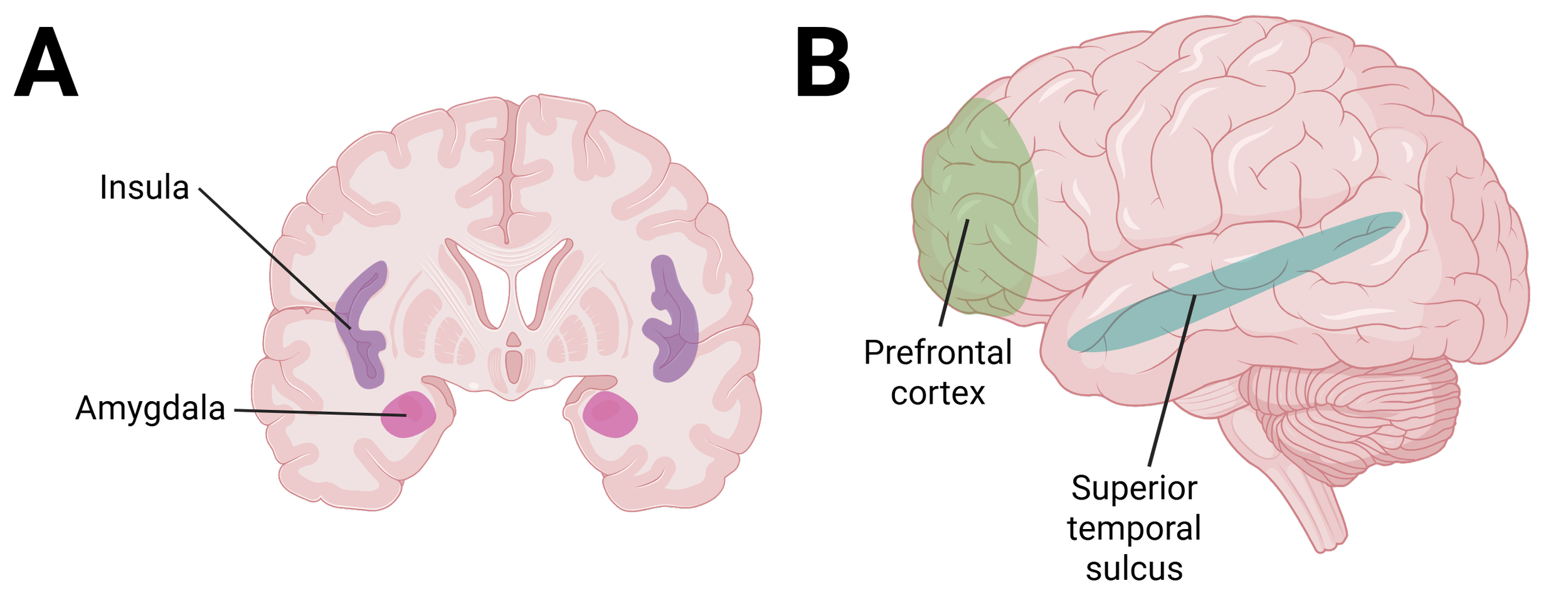
Several brain regions are also involved in recognizing and representing someone else’s emotions (left, A). The amygdala is a brain region known to be involved in learning, fear, and emotions. It allows us to recognize others’ emotions, especially when someone is afraid. When the amygdala is damaged, it is harder to recognize that someone is afraid [4]. It is also important for emotional contagion, or “catching” the same feelings as someone else [1]. The insula is another brain region involved in emotions and empathy. For example, the insula shows similar activity when seeing someone else show disgust (like making a face when tasting something bad) as when we ourselves express disgust. The insula also has increased activity when imagining the experiences of others, such as imagining them stubbing their toe [7]. However, these systems work automatically. This falls into emotional empathy, or the first part of the PAM. These are not the only systems in the brain that allow us to feel empathy for others.
Cognitive empathy is being able to understand why someone feels a certain emotion. It can even be imagining how someone might feel after a certain experience [4]. This imaginative process activates several brain regions (above, B). One such region is the medial prefrontal cortex, a region in the front of the brain involved in decision-making and processing complex information. This region is active while taking the perspective of someone else, in particular when thinking about how they feel [4,7]. The superior temporal sulcus, a region on the side of the brain involved in social cognition, also lights up when taking the perspective of someone else to understand their feelings [7].
Animals experience others’ emotions too!
So far, we’ve only talked about how humans feel empathy. But animals feel what others feel too! Animals will comfort others who are stressed or in pain, and this eases the stress or pain of the animal they are comforting [2, 8]. Monkeys and rats also have mirror neurons that activate when we watch others do things or feel things [3, 7]. When experimenters disrupt an animal’s mirror neuron activity while observing another animal in pain, the animal no longer “catches” the feelings of the other [3], showing that these mirror neurons are needed for emotional contagion.
Similar brain regions are involved in how animals feel what others feel and how humans feel what others feel. Just like in humans, the amygdala and prefrontal cortex are activated when animals catch the feelings of another animal [1, 2, 3, 8]. If these brain regions are damaged or inactivated, the animals no longer show the same feelings as the other animals [1, 2, 3].
Since both animals’ and humans’ brains work in similar ways to let us feel what others feel, we know that empathy is not something unique to humans. It likely evolved long ago to help us form strong relationships and communities, which helps both animals and humans survive.
References
Allsop, S. A., Wichmann, R., Mills, F., Burgos-Robles, A., Chang, C.-J., Felix-Ortiz, A. C., Vienne, A., Beyeler, A., Izadmehr, E. M., Glober, G., Cum, M. I., Stergiadou, J., Anandalingam, K. K., Farris, K., Namburi, P., Leppla, C. A., Weddington, J. C., Nieh, E. H., Smith, A. C., … Tye, K. M. (2018). Corticoamygdala transfer of socially derived information gates observational learning. Cell, 173(6). https://doi.org/10.1016/j.cell.2018.04.004
Burkett, J. P., Andari, E., Johnson, Z. V., Curry, D. C., de Waal, F. B., & Young, L. J. (2016). Oxytocin-dependent consolation behavior in rodents. Science, 351(6271), 375–378. https://doi.org/10.1126/science.aac4785
Carrillo, M., Han, Y., Migliorati, F., Liu, M., Gazzola, V., & Keysers, C. (2019). Emotional mirror neurons in the rat’s anterior cingulate cortex. Current Biology, 29(12), 2104. https://doi.org/10.1016/j.cub.2019.05.064
Perry, A., & Shamay-Tsoory-, S. (n.d.). Chapter 11: Understanding emotional and cognitive empathy: A neuropsychological perspective. In Understanding Other Minds: Perspectives from developmental social neuroscience (pp. 178–194). essay, Oxford University Press.
Preston, S. D., & de Waal, F. B. (2002). Empathy: Its ultimate and proximate bases. Behavioral and Brain Sciences, 25(1), 1–20. https://doi.org/10.1017/s0140525x02000018
Schnell, K., Bluschke, S., Konradt, B., & Walter, H. (2011). Functional relations of empathy and mentalizing: An fmri study on the neural basis of cognitive empathy. NeuroImage, 54(2), 1743–1754. https://doi.org/10.1016/j.neuroimage.2010.08.024
Shirtcliff, E.A., Vitacco, M.J., Graf, A.R., Gostisha, A.J., Merz, J.L. and Zahn-Waxler, C. (2009), Neurobiology of empathy and callousness: Implications for the development of antisocial behavior. Behav. Sci. Law, 27: 137-171. https://doi.org/10.1002/bsl.862
Wu, Y. E., & Hong, W. (2022). Neural basis of prosocial behavior. Trends in Neurosciences, 45(10), 749–762. https://doi.org/10.1016/j.tins.2022.06.008
Thumbnail image by Dylan Ramirez
Brain region image by Alex Ramirez via BioRender
Edited by Emma Hays