How do mice help us understand Autism Spectrum Disorder?
You may know that scientists use mice for research, and maybe you imagine they use mice to test medicine or whether makeup is safe for your skin, but we can also use mice to understand complex disorders like depression, addiction, or even autism spectrum disorder (ASD). While a mouse cannot have ASD (this is unique to humans), they can experience similar behavioral characteristics to people with ASD including deficits in social behavior, anxiety, or repetitive behaviors [1]. To learn more about ASD in humans, we can look more closely at these behaviors using what we call a mouse model.
What is a mouse model?
While scientists are still trying to figure out what causes ASD, we do know that among individuals with ASD there are certain genes that are more frequently mutated or disrupted [2]. Since we cannot directly look at the brains of people affected by ASD to see how these mutations affect them, many methods were developed to study these genes. For example, we can study how cells in a dish function when these genes are mutated [3]. While we get important information from these different methods, these approaches do not directly address how behavior is impacted due to these mutations. That’s where mice come in! We can put the same gene mutation or disruption that the patients have in a mouse to create what is called a mouse model. Mouse models allow us to study how specific mutations impact the mouse’s behavior and apply this knowledge to humans! A mouse model could be comparable to a toy model of a car. Putting a mutation in a mouse to see how it affects behavior would be like changing a part of the engine in a model car to see how it affects speed and driving ability. It would be much safer to test out this new engine in a smaller model rather than a full-sized car with humans in it. This is exactly why mouse models are so useful to science.
How do we study mouse behavior?
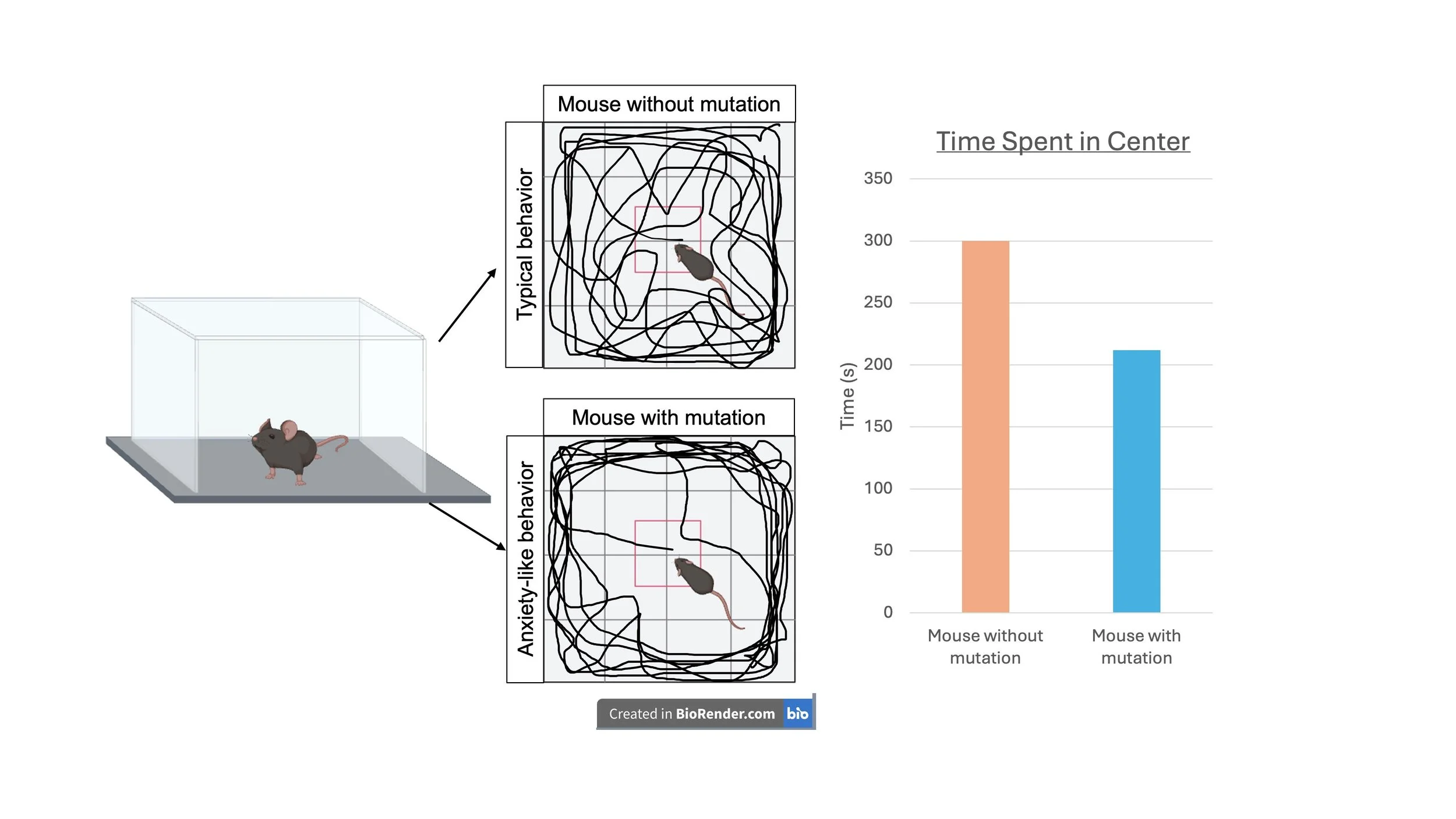
One question we can study using mouse models is why individuals with ASD have higher rates of anxiety [4]. While we cannot ask a mouse, “how do you feel today?” or “on a scale of 1-10, how anxious are you?”, we can watch how they behave on certain tasks and infer what may be causing that behavior. One test we use is called Open Field [5]. We place a mouse in an open square box, and we measure where it likes to spend its time. If you imagine you are a mouse, the corners of a box might feel the safest because you feel hidden, whereas the middle might feel scary since you are exposed to predators or danger. If a mouse spends more time in the corners than in the middle, we will say this mouse has “anxiety-like” behavior because they are acting more cautious of spending time in the center. Remember: we cannot say an animal has anxiety (like ASD, anxiety is unique to humans), but mice can behave in a similar way! The open field test may feel similar to walking into class on the first day of school. Do you feel anxious or excited about starting a new year and meeting new people? Will you hang back to the sides of the classroom and get a sense for who is there, who do you know, and see what people are doing? Or will you jump right into the middle and start socializing? Mice will approach an empty box in the open field test in the same way!
How does this relate back to individuals with Autism Spectrum Disorder?
When we test these mouse models of ASD on the open field test, we can see if disrupting a gene affects anxiety-like behavior. For example, if we see a mouse model with a specific gene mutation spend more time in the corners, exhibiting anxiety-like behaviors, we can say that mutations in that gene may be linked to the feelings of anxiety in humans with that same mutation. This helps doctors and scientists to figure out which genes they should target with new treatments or medication. This helps treatments and medicine to be more effective and better support patients!
References
Ey, E., Leblond, C. S. & Bourgeron, T. Behavioral profiles of mouse models for autism spectrum disorders. Autism Research4, 5-16 (2011). https://doi.org/https://doi.org/10.1002/aur.175
Satterstrom, F. K. et al. Large-Scale Exome Sequencing Study Implicates Both Developmental and Functional Changes in the Neurobiology of Autism. Cell180, 568-584.e523 (2020). https://doi.org/https://doi.org/10.1016/j.cell.2019.12.036
Willsey, H. R., Willsey, A. J., Wang, B. & State, M. W. Genomics, convergent neuroscience and progress in understanding autism spectrum disorder. Nature Reviews Neuroscience23, 323-341 (2022). https://doi.org/10.1038/s41583-022-00576-7
van Steensel, F. J. A., Bögels, S. M. & Perrin, S. Anxiety Disorders in Children and Adolescents with Autistic Spectrum Disorders: A Meta-Analysis. Clinical Child and Family Psychology Review14, 302-317 (2011). https://doi.org/10.1007/s10567-011-0097-0
La-Vu, M., Tobias, B. C., Schuette, P. J. & Adhikari, A. To Approach or Avoid: An Introductory Overview of the Study of Anxiety Using Rodent Assays. Frontiers in Behavioral NeuroscienceVolume 14 - 2020 (2020). https://doi.org/10.3389/fnbeh.2020.00145
Mouse behavior image created by Corinne Smith in BioRender
Thumbnail by Mila Okta Safitri on Unsplash
Edited by Emma Hays